Therefore, when planning rhinoplasty, the position of the nasal tip, nasal projection, dorsal lines, facial profile, and breathing function are evaluated as a whole along with the dorsal hump.
 (A classic "Before/After" profile comparison; a humped/long nose and a corrected, facially harmonious nose)
What does a humped and long nose structure mean?
A humped nose is when the bone and cartilage structure on the nasal dorsum creates a prominent protrusion in the profile. In some individuals, this can be accompanied by the nose appearing long, a drooping nasal tip, or a nasal tip that projects too far forward from the face.
In the Black Sea Region, it is common to encounter noses with prominent bone and cartilage structures; humped, long, and droopy-tipped noses. However, this does not mean everyone living in the region has the same nose structure. Skin thickness, cartilage strength, nose length, and facial proportions vary from person to person.
Therefore, a rhinoplasty plan should not be based on a specific nose type or a ready-made model, but on the individual's own anatomical features.
Why might simply reducing the nasal hump not be enough?
Reducing the nasal hump provides a significant change in the profile appearance. However, in humped noses, the problem is rarely just the protrusion on the nasal dorsum.
If the nasal tip projects too far from the face, the nose may still look long and large after the hump is reduced. If the nasal tip is droopy, merely correcting the hump may not provide profile balance. Similarly, an alteration made without considering the nasal root, upper lip, and chin structure can cause the nose to look disconnected from the rest of the face.
For this reason, along with how much the hump will be reduced, the following features are also evaluated in the surgical plan:
- How far the nasal tip projects forward from the face
- The length of the nose
- The angle and degree of droopiness of the nasal tip
- The transition between the nasal dorsum and the nasal tip
- Profile balance with the forehead, lips, and chin
- Functional problems inside the nose
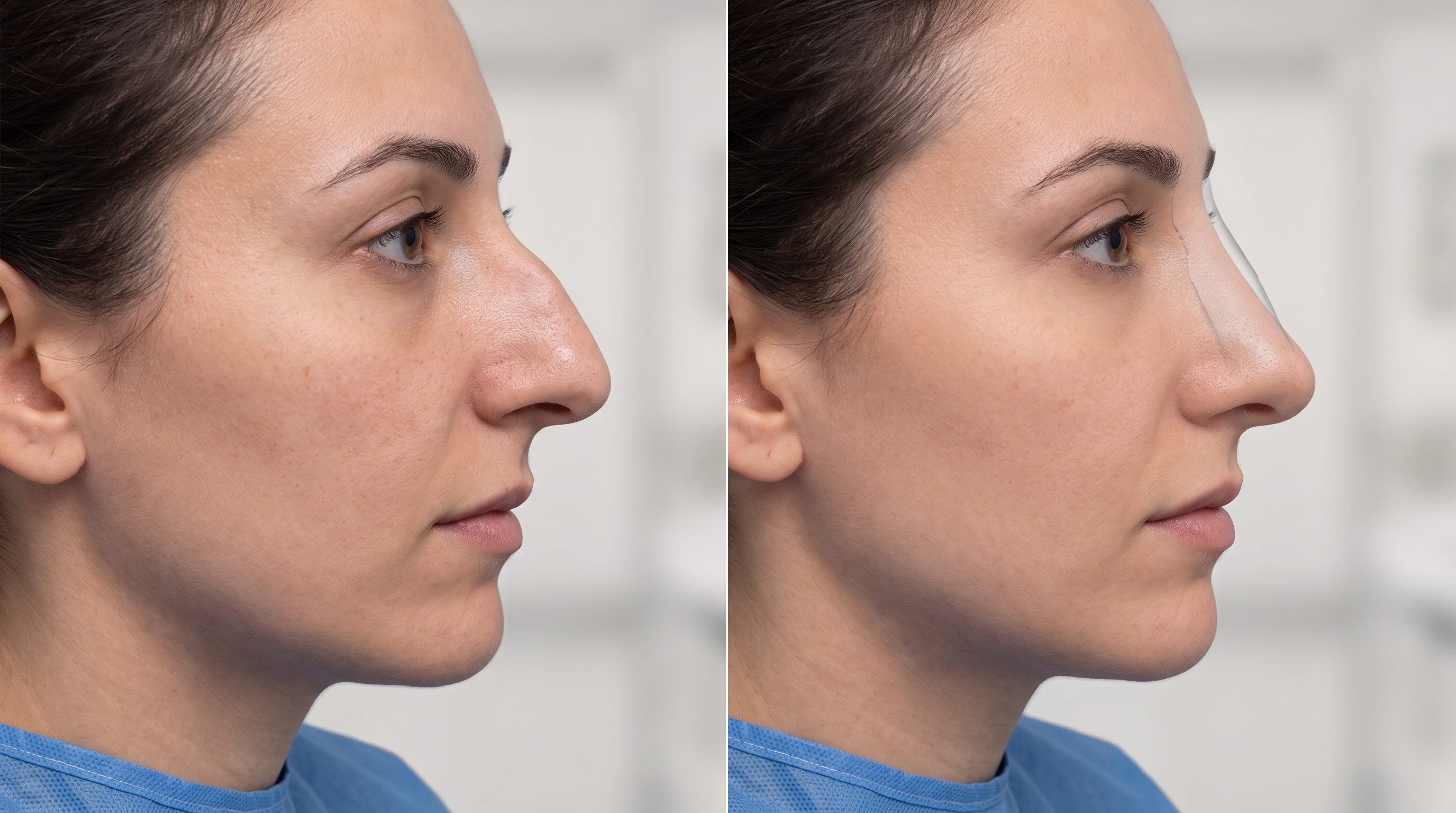 (A nasal profile with an over-projected (long) tip and a hump. It features an imaginary line showing only the hump removed; the tip remains too far forward and looks disproportionate)
The goal is not merely to shrink the nose, but to create an appropriate proportion between the different parts of the nose itself and the rest of the face.
What is deprojection?
In cases where the nasal tip projects too far forward from the face, the controlled reduction of this distance is called *deprojection*. In simpler terms, deprojection is the balancing of the nasal tip's forward protrusion according to facial proportions.
After deprojection, the nose may be perceived as shorter and less prominent from the profile. However, the alteration to be applied is not the same for every patient. The structure of the cartilages at the nasal tip, skin thickness, nasal dorsum, upper lip, and chin relationship must be evaluated together.
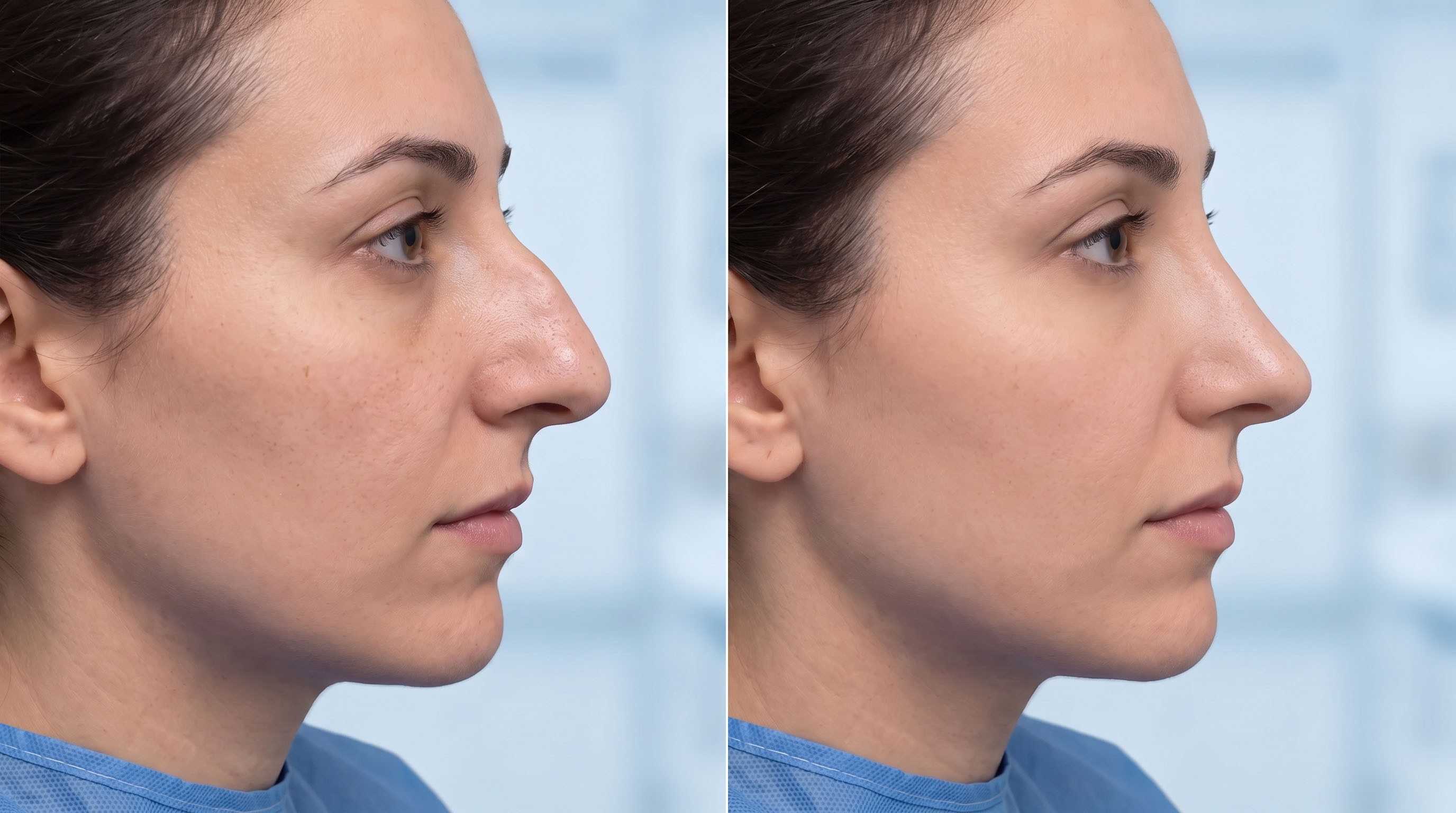 (A side profile visualizing the deprojection procedure. On the left, the nasal tip is too far forward (long); on the right, the nasal tip has been set back (deprojected) and shortened)
The target here is not to push the nasal tip back as much as possible. Excessive deprojection can negatively affect the natural support of the nose and its harmony with the face. Thus, the amount of change is determined by the individual's anatomical features.
Is deprojection the same procedure as nasal tip rotation?
Deprojection and nasal tip rotation define different changes that can be related to each other.
Deprojection is the reduction of the distance the nasal tip projects forward from the face. Rotation, on the other hand, is the controlled alteration of the angle of a drooping nasal tip. In other words, deprojection deals with the forward protrusion of the nasal tip, while rotation deals with its upward direction.
In humped, long, and droopy-tipped noses, these two changes may need to be planned together. Nevertheless, over-rotating (over-lifting) the nasal tip can disrupt the natural appearance and cause the nostrils to be overly visible when viewed from the front.
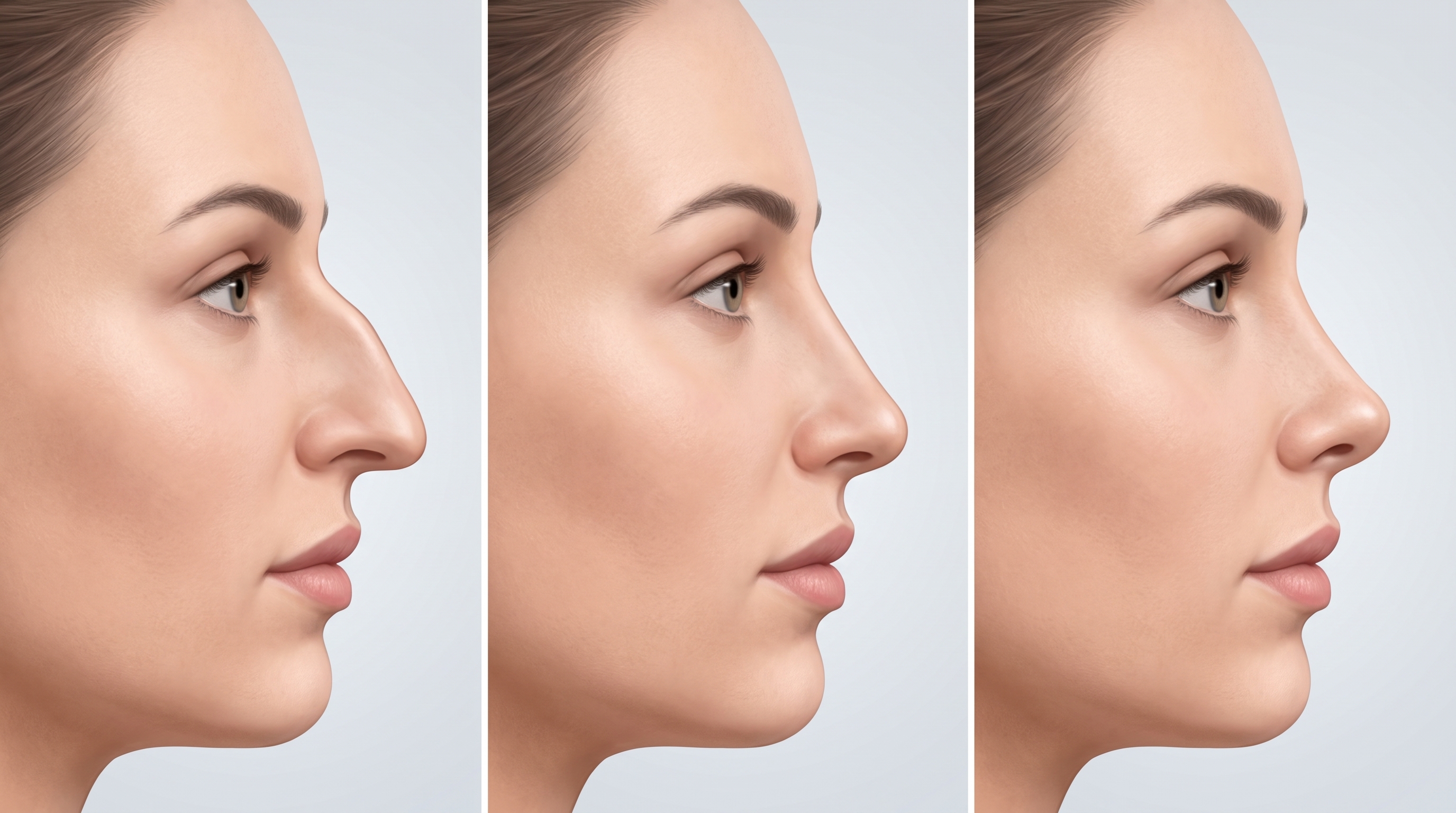 (A three-panel image demonstrating the difference between Deprojection (shortening) and Rotation (lifting): 1. Baseline, 2. Only Shortened, 3. Both Shortened and Lifted)
Therefore, the goal is not the most upturned nose possible, but a nasal tip position that is harmonious with the person's face.
The nasal dorsum and nasal tip must be evaluated together
When creating a natural profile, the relationship between the nasal dorsum and the nasal tip is crucial. How much to reduce the nasal hump is not decided solely by looking at the size of the hump. The nasal root, the length of the nasal dorsum, the position of the nasal tip, and the chin profile are also included in the planning.
A prominently curved or completely straight nasal dorsum is not targeted for every patient. While a slightly curved profile looks harmonious on some faces, a straighter and stronger nasal dorsum can better preserve the character of the face on others. Especially in male rhinoplasty, over-resecting the nasal dorsum or over-rotating the nasal tip can create an undesirable appearance.
The fundamental approach in rhinoplasty is not applying the same nose shape to everyone, but creating a plan in harmony with the individual's facial features.
Should breathing function be evaluated together with rhinoplasty?
Rhinoplasty is not solely about the external appearance of the nose. Inside the nose, there may be septal deviation, turbinate hypertrophy, or narrowing in the nasal valve area. An external deviation of the nose and an internal septal deviation can also be interconnected.
For this reason, a comprehensive intranasal examination is performed prior to surgery to evaluate the structures affecting breathing. When planning aesthetic changes, protecting the airway and addressing any functional problems must also be considered.
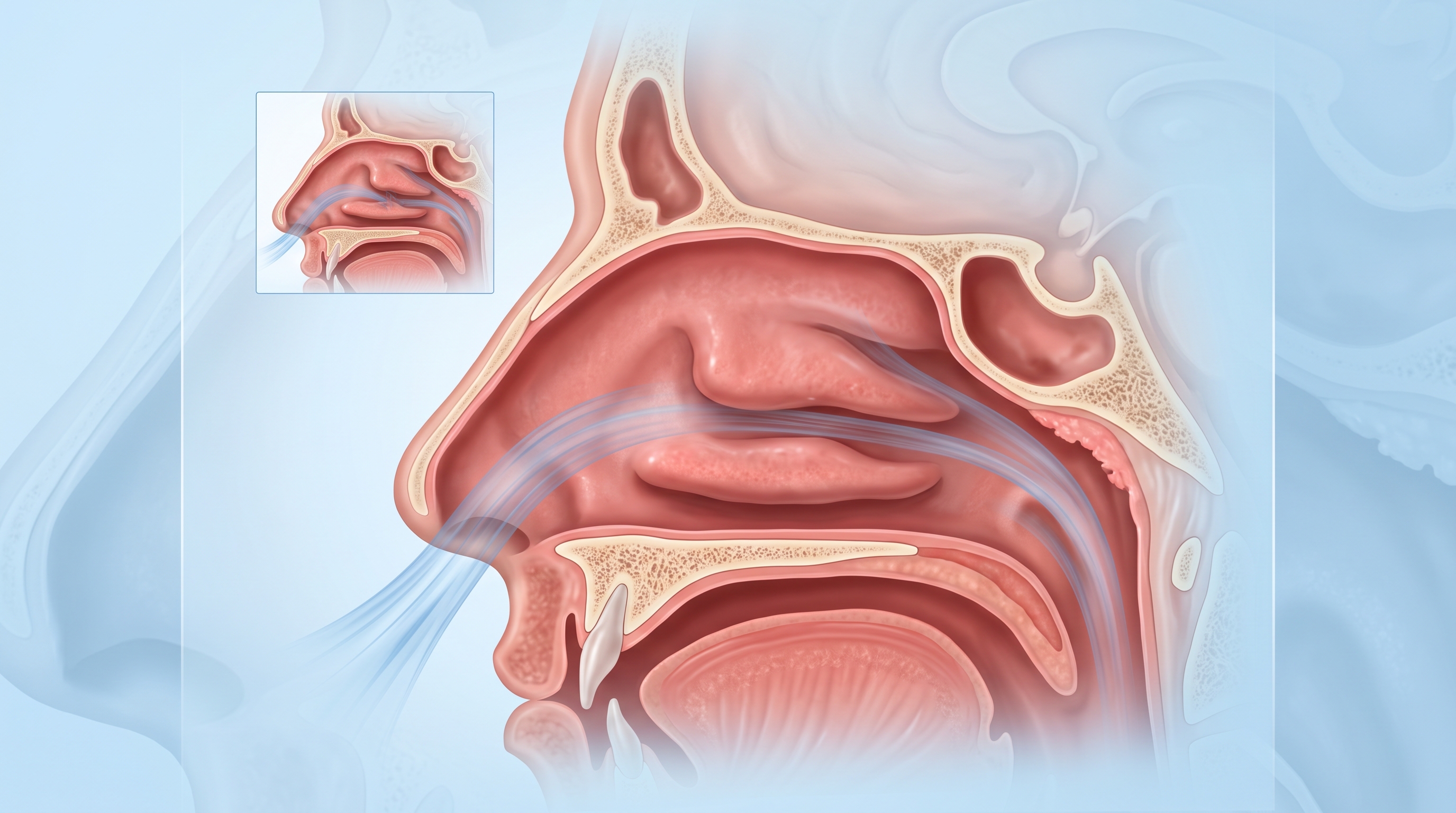 (Anatomical illustration profile showing the internal structure of the nose and airways.)
How is 3D simulation used in rhinoplasty planning?
Pre-operative 3D simulation helps in understanding the patient's expectations and jointly evaluating the potential effects of planned changes on the face.
During the simulation, reducing the nasal hump, balancing the nasal tip projection, changing the nasal tip angle, or comparing different nasal dorsum options can be achieved. Thus, terms like "natural," "straight," or "slightly curved," which can mean different things to different people, can be discussed more concretely.
 Çakırtepe Hospital 3D Simulation sampling
However, 3D simulation is not a guarantee of the post-operative appearance. Skin structure, cartilage characteristics, swelling (edema), and the healing process can affect the final result. Simulation is a planning tool that supports communication between the patient and the physician.
What is evaluated in a rhinoplasty consultation?
In a rhinoplasty consultation, first, the features the patient wants to change about their nose and their expectations from the surgery are listened to. Then, the nose is evaluated externally from different angles and internally in terms of breathing function.
Within the scope of the examination:
- Facial and profile proportions are analyzed.
- The nasal hump and dorsal lines are evaluated.
- The projection and rotation of the nasal tip are determined.
- Skin thickness and cartilage support are taken into consideration.
- The septum, turbinates, and airway inside the nose are evaluated.
- Possible changes are discussed through photo analysis and 3D simulation.
- The patient's expectations are compared with the surgically achievable changes.
The main question in rhinoplasty planning is not just "How much should the nasal hump be reduced?". How to balance the nose length, nasal tip, and facial profile all together must also be evaluated.
Conclusion
Rhinoplasty planning for humped and long noses is not limited solely to reducing the hump on the nasal dorsum. The projection of the nasal tip, its rotation, dorsal lines, facial profile, and breathing function must be handled collectively.
In rhinoplasty evaluations performed by Op. Dr. Nur Gül Güven at Private Ünye Çakırtepe Hospital, the anatomical features and expectations of the patient are evaluated together utilizing internal and external nasal examinations, facial and profile analysis, and 3D simulation.
 A natural and aesthetic outcome profile. The healed, facially integrated final state of the same patient as in the main article image (image_1)
Op. Dr. Nur Gül GüvenEar, Nose and Throat (ENT) Specialist